-
A grassed waterway, additionaly stabilized by fascines made out of cocos fibre net was
established in a zero-order basin (4 ha) to reduce thalweg erosion and the mobilization
of sediment, respectively. When planning this measure, the farmers' interests had to be
taken into account.
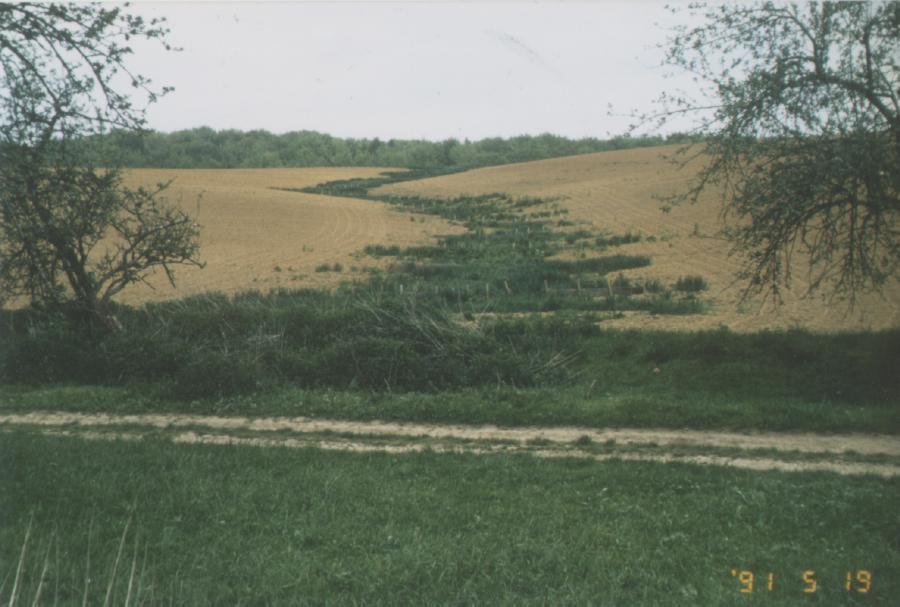
Grassed waterway (Photo: J. Baade) - A sediment retention area was established at the outlet of a first order-catchment (62 ha) to diminish sediment yield to the receiving watercourse.
- The establishment of the grassed waterway reduces ephemeral gully erosion by 50%.
-
The most important factor for the successful reduction of ephemeral gully erosion is the
establishment of a good grass cover at the bottom of the thalweg. Therefore, crossing
the grassed waterway with agricultural machinery has to be reduced to times of low soil
moisture conditions. Otherwise, considerable damage to the grass cover might occur,
which will heal only during the next spring and summer.
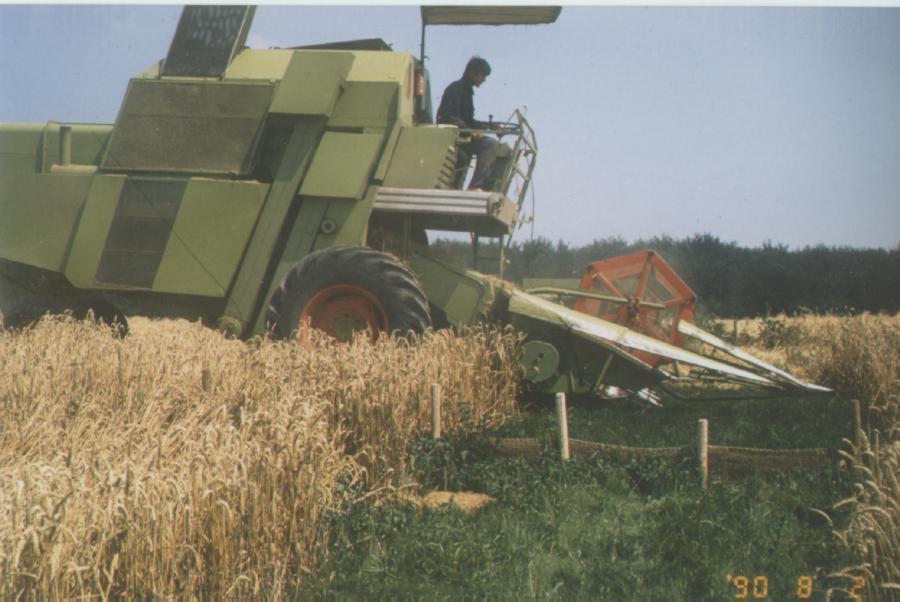
Crossing of the grass waterway with heavy maschinery (Photo: J. Baade) - The sediment retention area represents a very effective measure for diminishing sediment yield to receiving streams. A retention area equal to 1% of the arable land inside the catchment reduced the sediment yield from the catchment by an average of 60% over the 3-year study period. Also in this case, the most important factor was a good ground cover.
-
The single event efficency of the sediment retention area, expressed as sediment
retention ratio (R), depends strongly on the peak flow (Qmax) of the event:
R = 116,7 - 8,628 ln Qmax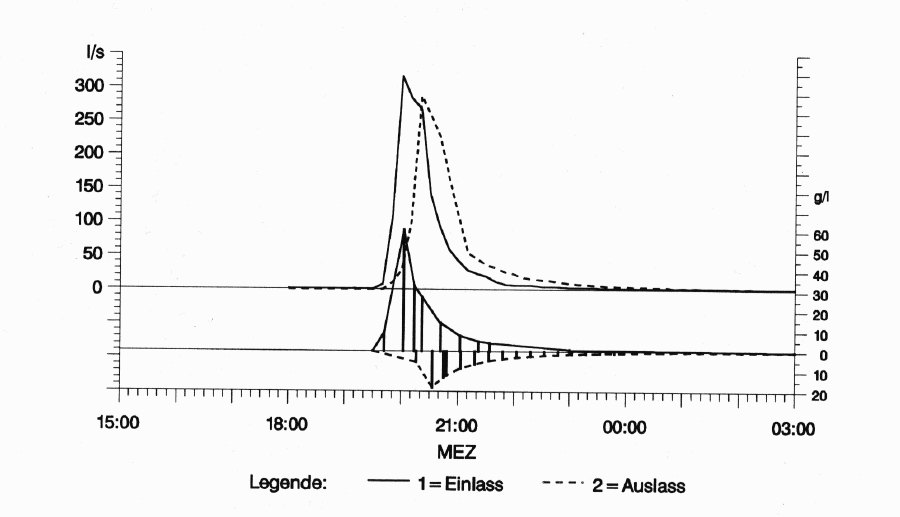
Runoff and sediment concentration at the inlet and the outlet of the sediment retention area, 21st July 1992 (from: Baade 1994, 174) - The reduction of the sediment yield from the first-order catchment shows clear effects on the sediment loading of the receiving stream. It was calculated that the sediment load of the receiving stream was reduced by 10% following the establishment of the retention area.
- At the beginning of the study it was assumed that the establishment of the retention area could additionally delay and reduce the peak flow from the first-order catchment. But the measurements clearly show that a small retention area will not interfere with runoff properties. Further measures have to be taken to design a retention area that is capable of reducing the risk of flooding downstream as well.
- It was calculated that inside of the catchment of gauge station 18 (705 ha) thalweg erosion accounts for 20% of the soil eroded. But these on-field damages are concentrated at the bottom of the thalweg, which normally means that the farmer is not that much concerned about them. Therefore, it seems necessary to point out that thalweg erosion accounts for 35% of the sediment load in the receiving stream. This means that thalweg erosion contributes considerably higher to off-site damages. In the smaller catchment, catchment Langenzell (62 ha), ephemeral gully erosion plays an even larger role. About 50% of the sediment yield from this catchment is derived from the thalwegs.

Sediment load of a small stream draining an intensively cultivated catchment area
in the loess-covered Kraichgau region (SW-Germany) (Photo: J. Baade)
In order to reduce the sediment yield from arable land to receiving streams, the following conservation measures were tested in a 3-year field experiment:

Gauge station 18 during a runoff event (Photo: J. Baade)
There is strong evidence that soil erosion as a source of nutrients and pollutants in the rivers and lakes will become more important in the near future. Therefore, soil conservation measures which aim at the reduction of off-site damages should be applied more often in the field. Furthermore, sediment retention areas could be incorporated into set aside schemes for biotopes. However, one should first study the implications of the higher nutrient input which accompanies the sedimentation in these areas.
 Top of page
back to publication list of J. Baade
Top of page
back to publication list of J. Baade© J. Baade (cub@geogr.uni-jena.de) | Last modification: 17.06.1997